Buyer's guide / Graphics cards
The best graphics cards of 2026
Five picks for five buyers: a halo card, a creator workstation, the last reasonable high-end value pick, the best 4K-per-dollar AMD card, and the budget GPU that finally has enough VRAM.
By Evan Cole · Last updated July 13, 2026
The 2026 GPU market is not the one we left at the end of 2024. NVIDIA's RTX 50 series and AMD's RDNA 4 launches both shipped early in 2025, but the real picture only settled this spring: GDDR7 memory shortages pushed RTX 5090 street prices well past MSRP, AMD's RX 9070 XT quietly outsold the RTX 5070 Ti at most European retailers, and Intel's Arc B580 turned into the budget card that actually shipped at MSRP for most of the cycle. For why prices are this high — and a clear rule on whether to buy now or wait — see our 2026 GPU prices and the memory shortage explainer.
We picked five cards for five different buyers. If you want the one-paragraph answer, jump to The bottom line. If you want to know exactly which GPU we'd buy at your budget, the five picks below cover every tier from under $300 to the halo tier, and a mid-range section covers the $300-550 value sweet spot (RX 9060 XT, RTX 5070, RTX 5060). Deciding between the two mid-stack value cards? See our RTX 5070 Ti vs RX 9070 XT head-to-head.
Last updated July 2026. Street prices are re-verified against live retailer listings each update; every performance figure below is synthesized from independent lab benchmarks (TechPowerUp, Gamers Nexus, Tom's Hardware), cited per pick. We don't accept payment for placement.
The verdict, at a glance
Most powerful
ASUS ROG Astral RTX 5090 White OC
The only halo card here — up to 27% faster than the RTX 4090 at 4K, with 32 GB of VRAM headroom no rival matches.
Best for creators & AI
MSI GeForce RTX 5080 (256-bit Extreme)
The creator's card — 16 GB of GDDR7 plus broad CUDA support, near-5090 gaming at 1440p for ~50% less.
Best value
VerdictBits's one 'buy this' card — within a couple FPS of the 5080, same 16 GB, launched at $749 and stayed there.
Best 4K value (AMD)
The best 4K value in the stack — within 12% of the RTX 5070 Ti at rasterized loads, often $200+ less.
Best budget
ASRock Challenger Intel Arc B580
The budget GPU that finally cleared the bar — 12 GB of VRAM at $249, sidestepping the 8 GB ceiling that bites the RTX 5060.
How we picked
VerdictBits's GPU recommendations are built on three signals, not one:
- Independent benchmark agreement. A card has to land in the top of its tier across at least three independent reviewers (Tom's Hardware, TechSpot, GamersNexus, TechPowerUp) before we'll recommend it. Our picks synthesize those independent results, cited per pick.
- Real-world availability and pricing. An MSRP that exists only in NVIDIA's marketing slides is a non-starter. We weight street pricing, average over the last 30 days, far more heavily than launch MSRP.
- Use-case fit, not just FPS. Developers and creators need CUDA, VRAM headroom for AI workloads, and quiet thermal design. Gamers want frame-time consistency at the resolution they actually play at. A card that wins one chart and loses every other is rarely the right answer.
We do not accept payment to recommend products. See our affiliate disclosure for how VerdictBits is funded, and our methodology page for the rest of the editorial standard.
1. The most powerful GPU in 2026 — RTX 5090 (ASUS ROG Astral)
— VerdictBits editorial score
Reasons to buy
- ~8/17/27% faster than RTX 4090 at 1080p/1440p/4K
- 32 GB GDDR7, 512-bit — most VRAM headroom
- Gap widens as resolution and ray-tracing rise
- ASUS ROG Astral: quad-fan, low noise, vapor chamber
Reasons to avoid
- Street $3,500+, well above $1,999 MSRP (~77% over)
- AIB models cleared $5,000 during the shortage
- 575 W TGP — needs a PSU sized around it
- CPU-limited below 4K ultra
For: 4K 240Hz gamers, video editors working in 8K or heavy AI / Stable Diffusion XL local inference, and anyone whose bottleneck is "I want all the performance, full stop."
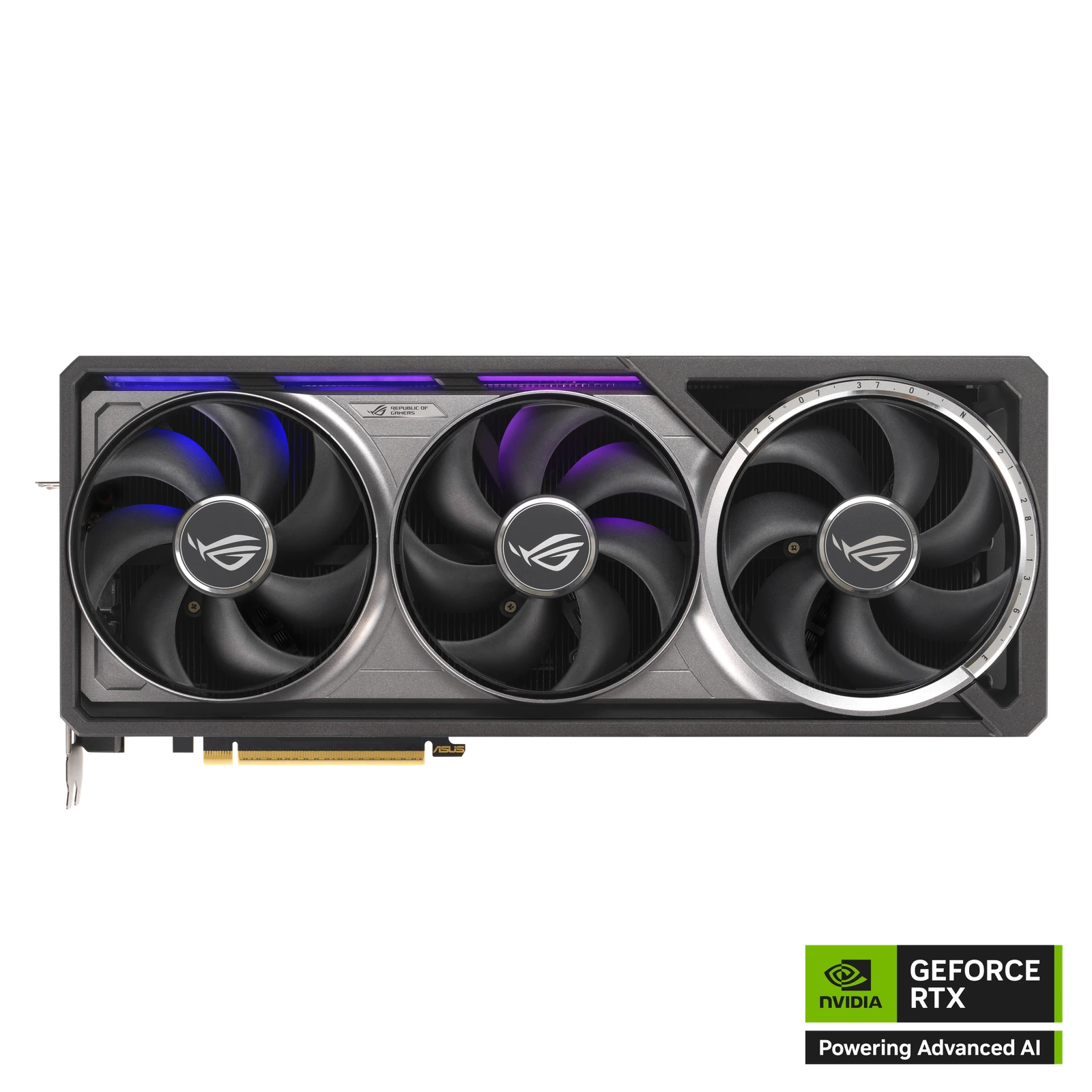
The RTX 5090 is the only card in this guide we'd call a halo product. It is faster than the RTX 4090 by roughly 8% at 1080p, 17% at 1440p, and 27% at 4K -- the gap widens as resolution and ray-tracing load go up. With 32 GB of GDDR7 on a 512-bit bus, it has more VRAM headroom than any creator workstation card we'd recommend at this price tier, and the 575 W TGP makes it the first consumer card we'd specifically size a power supply around.
The catch is the catch you already know about. GDDR7 memory shortages pushed 2026 street pricing well above NVIDIA's $1,999 MSRP -- by mid-2026 the cheapest stock for base models had climbed to around $3,500+ (roughly 77% over MSRP), with premium AIB models clearing $5,000 during the worst of the shortage. If you have to ask "is it worth it?", it isn't. The RTX 5090 is the right answer when you already know exactly which workload you're feeding it and the FPS or render time matters more than the dollars.
What we'd pair it with: a 1,000 W or larger 80+ Platinum power supply with native 12V-2x6 connectors, a high-refresh 4K monitor (the RTX 5090 is CPU-limited at anything below 4K ultra), and one of the modern AIO liquid coolers we cover in our best AIO coolers guide -- the RTX 5090's airflow envelope is aggressive enough that the CPU cooler matters.
The variant we'd buy: the ASUS ROG Astral White OC is the RTX 5090 board we'd actually put in this build -- a factory-overclocked, quad-fan flagship with a full vapor chamber, one of the lowest noise floors of any 5090, and a clean white shroud that suits a light-themed case at no premium over the black model.
Check current price on Amazon.
2. The best GPU for creators & AI in 2026 — RTX 5080 (MSI)
— VerdictBits editorial score
Reasons to buy
- 16 GB GDDR7 — Blender, DaVinci 4K, 7-13B LLMs at FP8
- CUDA broader and better-tested than ROCm/oneAPI
- Second-fastest here; trades only a couple FPS at 1440p
- Near-MSRP most of 2026 ($1,100–1,400 street)
Reasons to avoid
- Overkill below 1440p — buy a 5070 Ti instead
- 4K gap to the 5090 widens
- 16 GB ceiling vs the 5090's 32 GB
For: 3D artists, video editors, ML practitioners running Stable Diffusion XL or local LLMs, and anyone whose workload needs CUDA and at least 16 GB of VRAM without paying the RTX 5090 tax.
The RTX 5080 is the card we'd put on a developer or creator's desk if we had one slot, one budget, and one job to feed it. 16 GB of GDDR7 is enough for Blender Cycles scenes, DaVinci Resolve 4K timelines with a healthy stack of effects, and local inference of most current 7-13B parameter LLMs at FP8 with room left over. CUDA support is broader and better-tested than AMD's ROCm or Intel's oneAPI, which still matters for production pipelines today even if it shouldn't have to in 2030.
For pure gaming, the RTX 5080 is the second-fastest card in this guide and trades only a couple of FPS to the RTX 5090 at 1440p. At 4K the gap widens, but most 4K monitors top out at 144Hz where it doesn't matter. Where the RTX 5080 stops being the right call is below 1440p -- buy a 5070 Ti instead and put the savings into the rest of the workstation.
The RTX 5080 launched at $999 MSRP and, unlike the 5090, has been available close to MSRP for most of 2026. Street pricing settles in the $1,100-1,400 band for premium AIB models with better thermal design.
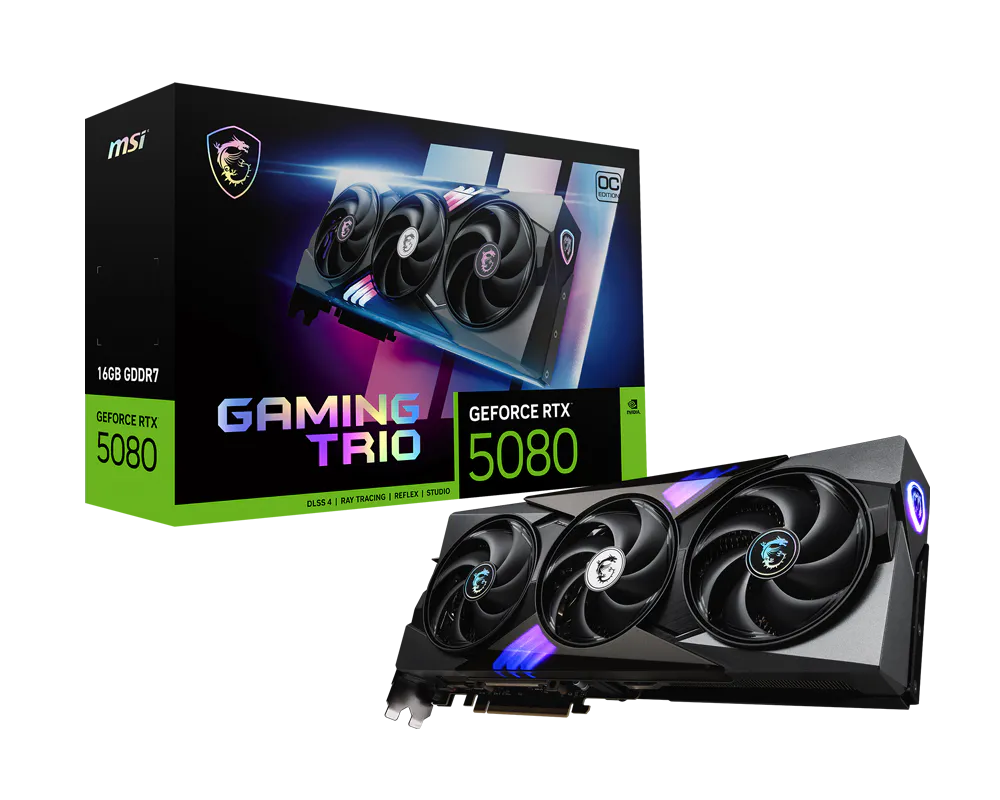
The variant we'd buy: MSI's RTX 5080 is a well-cooled triple-fan partner card that holds its factory boost through long Blender Cycles and DaVinci Resolve exports without the acoustic spikes of the reference-style designs -- the right 5080 for a workstation that lives next to a microphone.
Check current price on Amazon.
3. The best value GPU in 2026 — RTX 5070 Ti (ASUS TUF Gaming)
— VerdictBits editorial score
Reasons to buy
- Within a couple FPS of the RTX 5080 across the board
- Same 16 GB GDDR7 at a much lower price
- Launched $749 and stayed close through 2026
- ~300 W — more efficient than the RX 9070 XT
Reasons to avoid
- RX 9070 XT within 12% at 4K raster for less
- Street $850–950 above the $749 MSRP
- Last tier where dollars-per-FPS bends your way
For: 1440p high-refresh gamers, mixed gaming + creative workstations on a real budget, and anyone who wants near-5080 frame rates without the 5080 price tag.
If we could only put one card on VerdictBits's "buy this" list, it would be the RTX 5070 Ti. It lands within a couple of FPS of the RTX 5080 across the board, ships with the same 16 GB of GDDR7, and -- most importantly -- launched at $749 and stayed close to that number through 2026. The RTX 5070 Ti is the last card in NVIDIA's 50-series stack where the dollars-per-FPS line bends in your favor instead of away.
The RTX 5070 Ti is also meaningfully more power-efficient than the AMD card just below it. At full gaming load, the 5070 Ti pulls about 300 W -- 30 W less than the RX 9070 XT -- and the noise envelope on quality AIB cards reflects it. For a workstation that lives in a quiet room, the thermal headroom is worth real money.
The honest trade-off: if you live at 4K and prioritize raw rasterized frame rates over ray-tracing or DLSS 4 features, the RX 9070 XT below is within 12% at meaningfully lower cost. (Not sure whether to target 1440p or 4K in the first place? Our 1440p vs 4K gaming guide pairs each resolution to the GPU it needs.) The RTX 5070 Ti wins on feature set (DLSS 4 transformer model, CUDA, NVENC) and efficiency; the AMD card wins on raw value. Either is the right answer depending on whether NVIDIA's software stack matters to you.
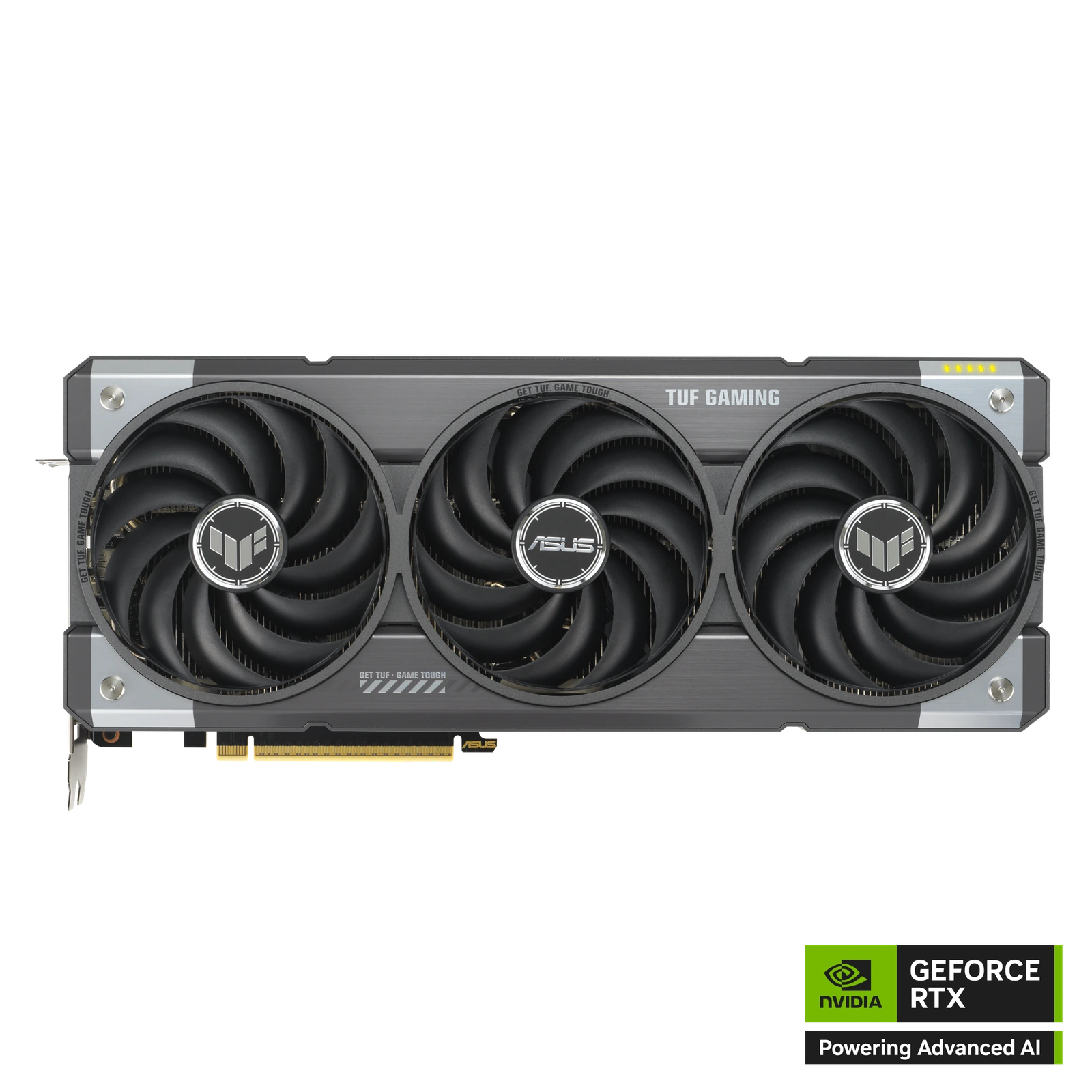
The variant we'd buy: the ASUS TUF Gaming RTX 5070 Ti pairs military-grade components with an oversized triple-fan cooler, which makes it one of the coolest and quietest 5070 Ti boards on the market -- and it's one of the variants that has most consistently stayed near the $749 MSRP this pick is built on.
Check current price on Amazon.
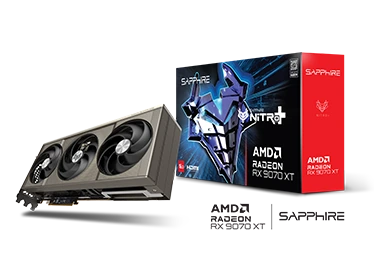
4. The best AMD GPU & best 4K value in 2026 — RX 9070 XT (Sapphire Nitro+)
— VerdictBits editorial score
Reasons to buy
- Within 12% of the RTX 5070 Ti at 4K raster
- 16 GB GDDR6 cushion for newer titles
- FSR 4 ML upscaler closed most of the gap to DLSS
- $599 MSRP, at or near it most of 2026
Reasons to avoid
- Trailing side on ray-tracing-heavy titles
- RTX 5080 better for CUDA-bound creator work
- ~304 W — ~30 W more than the 5070 Ti
For: 4K gamers who care about raw frame rates more than ray-tracing showcases, Linux users with mature open-source drivers, and anyone who's tired of paying NVIDIA's brand premium for the same FPS.
The RX 9070 XT is the card that finally lets us recommend AMD without an asterisk. It lands within 12% of the RTX 5070 Ti at 4K rasterized loads and, in a handful of titles where AMD's driver team has done the work, actually pulls ahead. The 16 GB of GDDR6 is a meaningful VRAM cushion for newer titles where 12 GB starts to thrash, and FSR 4's machine- learning upscaler closed most of the visual quality gap with DLSS that used to make Radeon a hard sell for image-quality-sensitive gamers.
The bigger story is the price. AMD launched the RX 9070 XT at $599 MSRP and -- crucially -- it has been available at or near MSRP for most of 2026. European retailer data tells the punchline cleanly: Mindfactory reports selling roughly 150% more RX 9070 XTs than RTX 5070 Tis, and aggregated EU sell-through has been similar. When the "AMD tax penalty" flips sign and AMD's card is the better deal, the value calculation gets very simple.
Where we'd still default to NVIDIA: CUDA-bound creator workflows (the RTX 5080 above is the better workstation pick), and anyone who specifically wants ray-tracing-heavy titles like Cyberpunk 2077 or Alan Wake II with path tracing on -- AMD's RT performance has improved but is still the trailing side of the gap.
The variant we'd buy: the Sapphire Nitro+ is the board Radeon buyers reach for first. Its cooler is the best on any RX 9070 XT -- the lowest noise floor in the lineup -- and the factory overclock closes a little more of the gap to the RTX 5070 Ti at no meaningful premium over reference cards.
Check current price on Amazon.
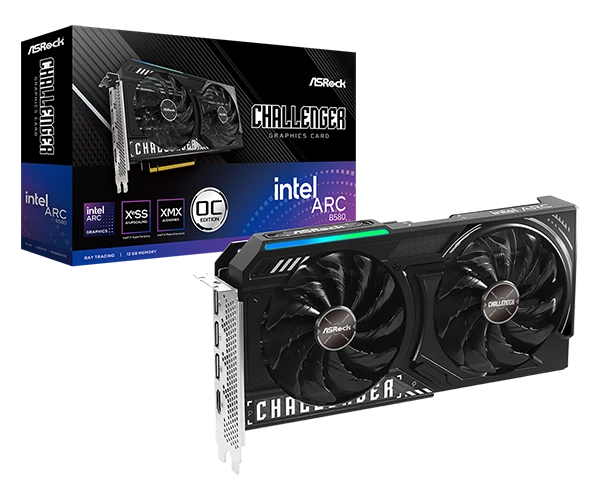
5. The best budget GPU in 2026 — Intel Arc B580 (ASRock Challenger)
— VerdictBits editorial score
Reasons to buy
- 12 GB GDDR6 sidesteps the 8 GB VRAM ceiling
- $249 MSRP and largely available near it
- Great for 1080p / entry 1440p + dual-monitor
- 190 W — forgiving on a 650 W supply
Reasons to avoid
- Software maturity trails NVIDIA on Day-One drivers
- RTX 5070 Ti still the call for Blender/SD/compile
- RTX 5060 Ti ~40% faster when VRAM isn't the limit
For: 1080p and entry-level 1440p gamers, dual-monitor productivity setups, and anyone who refuses to pay $400+ for a card that ships with 8 GB of VRAM in 2026.
The Intel Arc B580 is the budget GPU that finally cleared the bar in 2026. It launched at $249 MSRP and -- with one notable exception around the holiday rush -- has actually been available at or near that price. The 12 GB of GDDR6 sidesteps the issue we have with NVIDIA's RTX 5060 line: 8 GB of VRAM is no longer a credible amount in 2026, and the stutter and frame-pacing penalties when modern titles exceed it are real, measurable, and ugly — we break down exactly what breaks, and when 8 GB is still fine, in is 8GB of VRAM enough in 2026?
The case against the Arc B580 is software maturity. Intel's driver team has shipped a steady cadence of updates and the painful early-Arc title compatibility issues are largely behind them, but NVIDIA still wins on Day-One driver readiness for AAA launches and on the breadth of third-party tooling support. If you compile your own software, render in Blender Cycles, or care about Stable Diffusion inference performance, the RTX 5070 Ti is still the right call. If you play games at 1080p, run two or three monitors, and just want a GPU that won't choke on the next big release, the Arc B580 is the value pick of the cycle.
The RTX 5060 Ti edges the Arc B580 by roughly 40% in pure FPS when VRAM isn't the limiter, but it costs $429 -- a 72% price premium for a 40% performance edge that disappears the moment VRAM matters. The math only works for the 5060 Ti if you specifically need CUDA or DLSS 4 and you're willing to live with 8 GB.
The variant we'd buy: the ASRock Challenger is a compact dual-fan B580 that drops into small-form-factor builds, runs quiet under load, and is the variant that has most reliably held the $249-260 price the Arc B580 earns its budget recommendation on.
Check current price on Amazon.
The five picks, side by side
| Card | Best for | VRAM | Street price (2026) | MSRP | Standout |
|---|---|---|---|---|---|
| ASUS ROG Astral RTX 5090 White OC | Most powerful | 32 GB GDDR7 | $3,500+ street (DRAM-shortage premium) | $1,999 MSRP | Top-end 4K 240Hz + creator workloads (CUDA, AI, video) |
| MSI GeForce RTX 5080 (256-bit Extreme) | Best for creators & AI | 16 GB GDDR7 | $1,100-1,400 street | $999 MSRP | CUDA + 16 GB VRAM sweet spot for Blender, Stable Diffusion, DaVinci |
| ASUS TUF Gaming RTX 5070 Ti | Best value | 16 GB GDDR7 | $850-950 street | $749 MSRP | Within a couple FPS of the RTX 5080 for ~25% less money |
| Sapphire Nitro+ RX 9070 XT | Best 4K value (AMD) | 16 GB GDDR6 | $650-750 street | $599 MSRP | Within 12% of the RTX 5070 Ti at 4K, often $200+ less |
| ASRock Challenger Intel Arc B580 | Best budget | 12 GB GDDR6 | $260-300 street | $249 MSRP | 12 GB VRAM at $249 sidesteps the 8 GB ceiling that bites the RTX 5060 |
Street prices are 30-day averages from live US retailer listings, last verified July 2026. TDP, memory bus, bandwidth and core counts for all five cards (plus eight more) are in the 2026 GPU benchmark hierarchy.
Want the wider field? Our 2026 GPU comparison & benchmark hierarchy puts 13 current and recent cards in one sortable table -- specs, MSRP, a relative-performance index, and value per dollar -- if you want to compare beyond these five picks.
The mid-range and 1080p tier: best value GPUs under $550
Our five main picks span the budget ($249 Arc B580) to the halo tier ($3,500 RTX 5090), but the biggest-volume slice of the market -- the $300-550 mainstream cards for 1080p and 1440p -- deserves its own answer. If the $599 RX 9070 XT and $749 RTX 5070 Ti are more than you want to spend, these three are where most 2026 builders actually shop. Figures below are synthesized from independent lab benchmarks (TechPowerUp, GamersNexus, TechSpot, Tom's Hardware), cited.
What is the best value / mid-range GPU in 2026? — Radeon RX 9060 XT 16GB
AMD's $349 RX 9060 XT (16GB) is the mid-range card to beat. 16 GB of GDDR6 at this price sidesteps the 8 GB VRAM ceiling entirely, it draws just 160 W, and independent benchmarks place it between the RTX 5060 Ti and RTX 3070 Ti at 1440p -- the best raster-per-dollar 1080p and 1440p pick of the cycle. The trade-offs are weaker ray tracing than NVIDIA and a narrow 128-bit bus (~322 GB/s) that caps it above 1440p. One buying note: get the 16 GB version, not the confusingly-named 8 GB sibling that shares the name.
What is the best 1440p all-rounder under $600? — GeForce RTX 5070
At $549, the RTX 5070 (12 GB GDDR7) is the fastest of this tier -- roughly RTX 4070 Super raster with the best ray tracing, DLSS 4 and efficiency in the class. It's the pick when 1440p high-refresh with ray tracing is the goal and you want NVIDIA's software stack (DLSS 4, CUDA, NVENC). The honest catch: 12 GB is already tight in path-traced titles, and it's a near-flat gen-on-gen gain over the 4070 Super -- buy it on current price, not the "50-series" badge. It has spent parts of 2026 up to ~15% over MSRP, so watch street pricing.
What is the best budget 1080p GPU in 2026? — GeForce RTX 5060
The $299 RTX 5060 (8 GB) is a capable 1080p card -- better-than-console-class raster, DLSS 4 Multi-Frame Generation, and very efficient at 145 W. But the 8 GB of VRAM is the defining limit: it stalls on modern AAA textures and ray tracing beyond 1080p. For $50 less, Intel's Arc B580 gives you 12 GB; we'd take the extra VRAM unless you specifically need CUDA or DLSS 4. Treat the RTX 5060 as a pure 1080p / esports pick.
| Card | Best for | VRAM | MSRP | Street (2026) |
|---|---|---|---|---|
| Radeon RX 9060 XT 16GB | Best value 1080p / 1440p | 16 GB GDDR6 | $349 | ~$350-400 |
| GeForce RTX 5070 | Best 1440p all-rounder (RT / DLSS 4) | 12 GB GDDR7 | $549 | ~$550-620 |
| GeForce RTX 5060 | Best budget 1080p (8 GB caveat) | 8 GB GDDR7 | $299 | ~$300-330 |
Where they land in raw performance: RTX 5070 Ti ≈ RX 9070 XT (our high-end value picks) > RTX 5070 > RX 9060 XT 16GB > RTX 5060 > Arc B580.
What we considered but didn't pick
Two more GPUs came close and got cut for specific reasons worth naming (the mainstream RTX 5070, RX 9060 XT and RTX 5060 are covered in the mid-range tier above):
- AMD Radeon RX 9070 (non-XT) -- closer to RTX 5070 in performance than to the 9070 XT, but the price gap between the non-XT and the XT at most retailers has been smaller than the performance gap. Spend the extra $50-80 and step up.
- NVIDIA RTX 5060 Ti -- the 8 GB SKU is a non-starter in 2026 and the 16 GB SKU costs more than an Arc B580 plus enough money left over for a decent SSD. The math only works in narrow CUDA-bound creative workloads.
Buying advice
Three things worth knowing before you click buy:
- Size the power supply to the card, not the other way around. The RTX 5090's 575 W TGP and transient spike behavior put it in 1,000 W-or-larger 80+ Platinum territory. The RTX 5080 and RX 9070 XT both want at least 850 W with native 12V-2x6 (NVIDIA) or 8-pin (AMD) connectors. The RTX 5070 Ti and Arc B580 are forgiving on 750 W or 650 W respectively.
- Don't buy a card faster than your monitor. The RTX 5090 is wasted on a 60Hz 1080p panel. If you're not already on a 4K 120Hz+ monitor, the savings between a 5090 and a 5070 Ti will cover most of a great display.
- Don't count on the SUPER refresh. NVIDIA has historically shipped SUPER refreshes mid-generation, but the rumored RTX 50 SUPER has been repeatedly reported as delayed or possibly cancelled — it needs the same scarce 3 GB GDDR7 the memory shortage made hard to get, with CES 2027 floated as the earliest window. Treat it as a maybe, not a plan; see our 2026 GPU prices explainer for the full picture.
- Support a heavy card so it doesn't sag. Modern flagships like the RTX 5090 are long, dense triple-slot cards, and over months their own weight can bow the PCIe slot and PCB — "GPU sag." A support bracket, an adjustable pillar or magnetic-base stand under the card's far end, is a cheap fix; the CyberPrism Monolith is one such ARGB bracket (adjustable 75–125 mm, magnetic base, ~$19) sized for RTX 30/40/50-series cards. Check on Amazon →
Frequently asked questions
What is the best value GPU in 2026?
For most builders, the RTX 5070 Ti -- it lands within a couple percent of the RTX 5080 for roughly 25% less and keeps 16 GB of VRAM. If you game at 4K and don't need CUDA or heavy ray tracing, AMD's RX 9070 XT is the best raster-per-dollar pick, often $200+ cheaper for similar frame rates in aggregated independent benchmarks.
What is the best budget graphics card in 2026?
The Intel Arc B580 at a $249 MSRP. Its 12 GB of VRAM sidesteps the 8 GB ceiling that hampers similarly priced RTX 5060 cards, and it handles 1080p and entry 1440p comfortably. The trade-off is Intel's less mature drivers versus NVIDIA on some day-one AAA launches.
What is the most powerful GPU in 2026?
The GeForce RTX 5090 -- roughly 8/17/27% faster than the RTX 4090 at 1080p/1440p/4K in independent testing, with 32 GB of GDDR7. It is a halo card: 2026 street pricing sat around $3,500+ (well over its $1,999 MSRP) during the GDDR7 shortage, so it only makes sense when render time or maximum FPS genuinely pays for the card.
Is the RTX 5090 worth it over the RTX 5080?
Only if you specifically need the extra VRAM (32 GB vs 16 GB) for AI inference at larger model sizes, or if you have a 4K 240Hz+ monitor and the budget to feed it. For pure gaming at 1440p or 4K 144Hz, the RTX 5080 trades a single-digit-percent FPS deficit for ~50% less money.
Is AMD or NVIDIA better for gaming in 2026?
It depends on what you value. AMD's RX 9070 XT gives the best rasterized frame rates per dollar and 16 GB of VRAM, and FSR 4's ML upscaler closed most of the image-quality gap. NVIDIA still leads on ray tracing, DLSS 4, CUDA and NVENC. For pure value gaming, AMD; for ray-tracing showcases, streaming, or creative work, NVIDIA.
How much VRAM do I need for gaming in 2026?
12 GB is the practical floor for 1080p and 1440p at high settings in 2026 -- 8 GB cards now stutter in several modern titles once texture budgets exceed it. 16 GB is the comfortable target for 1440p high-refresh and 4K, and adds headroom for creator and local-AI workloads. See our is-8GB-VRAM-enough guide for exactly when 8 GB still works.
Is the RX 9070 XT a better buy than the RTX 5070 Ti?
For pure 4K rasterized gaming on a budget, yes -- it lands within 12% of the 5070 Ti at significantly lower street pricing. For mixed creative work, CUDA-bound workloads, or ray-tracing-heavy titles, the RTX 5070 Ti is the better workstation pick.
Should I buy a used RTX 4090 instead?
A used RTX 4090 at the right price (under $1,200) is still a strong card -- it sits between the 5070 Ti and 5080 in pure raster, and has 24 GB of VRAM. The trade-offs are the warranty (gone or transferred), DLSS 4's transformer model (RTX 50-only on some features), and the used GPU market's well-known mining-card problem. We'd buy new at the 5070 Ti or 5080 tier unless the used pricing is exceptional.
The bottom line
Most workstation builders should buy the RTX 5070 Ti -- it is the last card in the 50 series where the price-to-performance line bends in your favor, and the 16 GB of VRAM has enough headroom for both 1440p high-refresh gaming and most creator workloads. If your work is CUDA-heavy (Blender, Stable Diffusion XL, DaVinci Resolve), step up to the RTX 5080. If you live at 4K and just want frame rates, the RX 9070 XT is the best value in the entire stack. The RTX 5090 is for professionals whose render time pays for the card, and the Intel Arc B580 is the budget GPU that finally deserves the recommendation it's been chasing for three generations.
Whatever you pick, give it a quiet AIO cooler and a power supply sized with headroom. Both will outlast the GPU.
Tempted to hold out for next-gen? We track the RTX 6090 rumors -- but it's a 2027 story at the earliest, and most of the circulating "specs" trace to a single leak. Nearer term, the RTX 50 Super refresh is the more immediate NVIDIA rumor, and AMD is rumored to answer with an RDNA 5 flagship on a similar timeline. For a build you're making this year, the cards above are the ones that actually exist; the full field is in our 2026 GPU comparison table.
Related buyer's guides
All reviews →Buyer's guide / GPUs
GPU FPS benchmarks 2026: what FPS will you actually get?
The honest version: real rendered FPS with native separated from DLSS/FSR frame generation - because a '5070 = 4090' claim only holds with fake frames on. What current GPUs actually deliver, and how to match FPS to your monitor and build.
Read the guide →
Buyer's guide / GPUs
RTX 5090 vs RTX 5080: which should you buy?
The 5090 doubles the 5080's VRAM, compute and price. For gaming that's rarely worth it; for VRAM- or CUDA-bound creator and AI work it often is. A sourced head-to-head plus a clear buying call.
Read the comparison →
Buyer's guide / GPUs
RTX 5070 Ti vs RX 9070 XT: which should you buy in 2026?
Roughly tied at 1440p, the 5070 Ti edges 4K and wins ray tracing, creation and local AI; the 9070 XT wins raster-per-dollar — a gap the 2026 memory shortage widened. Sourced head-to-head plus a verdict by use case.
Read the comparison →
Buyer's guide / GPUs
Is 8GB of VRAM enough in 2026? (RTX 5060 Ti 8GB vs 16GB)
Same chip, twice the memory: the RTX 5060 Ti 8GB vs 16GB isolates VRAM as the only variable. It holds up at 1080p esports and falls off a cliff almost everywhere else. Sourced benchmarks, plus ray tracing, frame gen and local-AI VRAM costs, and a clear buy rule.
Read the guide →
Buyer's guide / GPUs
DLSS 4 vs FSR 4 in 2026: which upscaler is actually better?
DLSS still leads on image quality and game support; AMD counters with universal AFMF 2 frame generation and lower prices. The accurate, sourced head-to-head (DLSS 4.5 vs FSR 4/Redstone) — and whether it should sway your GPU.
Read the comparison →
Buyer's guide / GPUs
1440p vs 4K gaming in 2026: which should you game at?
1440p is the 2026 sweet spot for most; 4K is for immersion and creators with the GPU budget. The honest breakdown — and, unlike the monitor sites, the exact GPU tier to pair with each resolution and refresh target.
Read the comparison →